Accounting for Decentralized Finance (DeFi) and Crypto-Native Businesses: The New Ledger
Let’s be honest. Traditional accounting feels a bit… grounded. It’s built for a world of centralized banks, paper trails, and predictable revenue cycles. Now, imagine trying to use those same tools to track assets zipping across a dozen blockchain protocols at the speed of light, earning yield from a pool you don’t control, or managing a treasury that’s partly in a meme coin. That’s the daily reality for crypto-native businesses.
Accounting for DeFi transactions isn’t just a technical challenge—it’s a fundamental rethink of what value, assets, and even a transaction are. Here’s the deal: if your business lives on-chain, your books need to speak the language.
Why DeFi Accounting Breaks the Old Model
Think of a classic business transaction. There’s an invoice, a payment from a known entity, and a record in your bank statement. It’s a neat, closed loop. DeFi? It’s more like a bustling, 24/7 global marketplace where actions are simultaneous and intermediaries are lines of code.
The core pain points are, well, numerous. First, pseudonymity. Transactions are between wallet addresses, not “Acme Corp.” This makes counterparty identification—a basic audit requirement—a puzzle. Then there’s the sheer volume and complexity. A single user interaction with a DeFi protocol might involve multiple token swaps, liquidity provision, and reward claims in one bundle. That’s several accounting events right there.
And the kicker? Real-time, on-chain finality. The transaction is the settlement. There’s no “accounts receivable” waiting period. The asset moves instantly, creating an immediate, irreversible accounting event. This demands a proactive, not reactive, bookkeeping approach.
Untangling the DeFi Transaction Knot
So, how do you categorize these on-chain activities? Let’s walk through some common DeFi actions and their accounting headaches.
1. Yield Farming & Liquidity Provision
You provide ETH and a stablecoin to a liquidity pool. In return, you get LP (Liquidity Provider) tokens and start earning fees. For accounting, this is a doozy.
- Asset Transfer: Your original tokens leave your wallet. That’s a disposal.
- LP Token Receipt: These represent your claim on the pool. But what’s their cost basis? It’s typically the fair market value of the assets you deposited at the time.
- Accruing Fees: Rewards accumulate constantly. Are they income the moment they’re generated, or only when claimed? Most experts argue for accrual accounting—recognizing the income as it’s earned, even if it’s not in your wallet yet. You know, matching principle and all that.
2. Staking and Governance
Locking tokens to secure a network or vote on proposals. Often, you get staking rewards. The big question: are these rewards ordinary income? Usually, yes. Their value at the time of receipt becomes taxable income, and that value sets their new cost basis.
But what about the locked principal? It’s still your asset, but it’s illiquid. That might require a note in the financials about restricted assets. A subtle but crucial disclosure.
3. Token Swaps and Decentralized Exchanges (DEXs)
Swapping Token A for Token B on a DEX is a taxable event in most jurisdictions. You’ve disposed of Token A (possibly realizing a gain or loss) and acquired Token B at a new cost basis. Tracking this across thousands of micro-transactions is where manual spreadsheets go to die.
The table below sums up the chaos—I mean, the challenge:
| DeFi Activity | Accounting Event | Key Challenge |
| Provide Liquidity | Disposal of Assets; Acquisition of LP Token; Accrual of Fee Income | Valuing LP tokens; Accruing micro-rewards in real-time |
| Claim Farming Rewards | Receipt of Income (FMV at claim time) | Tracking cost basis for new tokens immediately |
| Token Swap on DEX | Disposal of Asset A; Acquisition of Asset B | Identifying each swap as a taxable event amid high volume |
| Stake Tokens | Possible reclassification as restricted asset; Accrual of staking rewards as income | Distinguishing between principal (asset) and reward (income) |
Building a Framework for Crypto-Native Businesses
For a business that operates primarily on-chain—a DAO, a protocol treasury, a Web3 startup—accounting isn’t a back-office function. It’s strategic. Here’s a loose framework to build on.
- Wallet as Ledger: Treat every wallet address as a distinct cash account or sub-ledger. Segment them by purpose: operational treasury, cold storage, liquidity pool commitments. This is your source of truth.
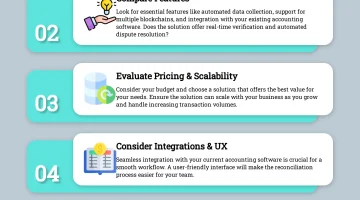
- Automate, Then Verify: Manual entry is impossible. Use blockchain accounting software (tools like Cryptio, Ledgible, or Bitwave) that pull raw on-chain data via APIs. But—and this is a big but—you must reconcile. Ensure the software’s interpretation of a complex swap matches yours.
- Adopt a Consistent Valuation Policy: Crypto is volatile. Do you mark-to-market daily? Weekly? For which assets? You need a clear, documented policy for valuing holdings, especially illiquid or vesting tokens. Stick to it.
- Embrace the “Proof” in Proof-of-Stake: Your audit trail is the blockchain. Transaction hashes are your receipts. Educate your auditor on how to read a block explorer. Seriously, this is now part of the job.
- Context is King: Tag your transactions. Was this swap for paying a contractor? A market-making operation? A community grant? Adding this narrative context turns chaotic data into intelligible business intelligence.
The Human Element in a Code-Driven World
All this tech talk can make it seem purely mechanical. It’s not. Judgment calls are everywhere. Is a governance token you hold an intangible asset? An investment? Maybe even inventory? The answer changes everything on the balance sheet.
And then there’s the regulatory fog. The rules are shifting, honestly, by the month. Accounting for DeFi means building a system that’s both precise enough to satisfy today’s guidelines and flexible enough to adapt to tomorrow’s.
In fact, that’s the ultimate takeaway. For crypto-native businesses, robust accounting isn’t about compliance for its own sake. It’s about creating a clear, trustworthy financial narrative. It’s about translating the innovation and velocity of on-chain activity into a language that investors, regulators, and the broader market can understand—or at least start to. That translation, that bridge between the old ledger and the new, is where the real value gets built. Not just on the blockchain, but on the books.